

Ball valves-Valves

Compression Fittings

u2-Lok Twin ferrule fittings

Threaded Fittings

Ball valves, Valves

Clino Aseptic Connections

Cone Sealing Couplings

Weld Fittings

Hose Fittings

Hoses

Hydraulic Adaptors

Push-In/On Connectors

Tubes

Pipe Clamps

Filter Technology

Quick Release Couplings
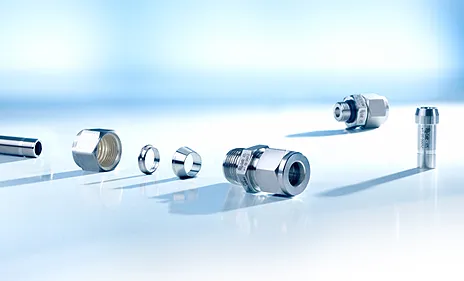
H2-Lok Twin ferrule fittings

Cavity Free Ecotube Couplings

Small flange connections DIN 28403

Flare fittings

37° JIC Flare Fittings

Measuring and Control Technology

Instrumentation Thread Adapter

Flanges

Butt Weld Fittings

High Pressure Soldering Fittings

Aquapress compression fittings

Assembly aids
Ball Valves, Valves, and Fittings
Various stainless steel fittings are available depending on the application. The various designs cover a wide range of applications in terms of functionality, pressure, temperature, and media. Ball valves are used to shut off or allow the flow of liquids, gases, and other media. Needle valves are compact fittings for the precise regulation and shutoff of liquid and gaseous media. Check valves prevent the backflow of liquid and gaseous media in piping and systems.
European pressure equipment directive PED 2014/68/EU
Range A and V (fittings and valves):
All products are developed and manufactured in accordance with Article 4.3 of the European Pressure Equipment Directive PED 2014/68/EU. Products with nominal diameters of more than 25 mm up to and including 32 mm must not be used for pumping liquid or gaseous fluids of group 1 (hazardous) according to the Pressure Equipment Directive PED 2014/68/EU. Products with nominal diameters greater than 32 mm may only be used for pumping group 2 (non-hazardous) liquid fluids according to the Pressure Equipment Directive PED 2014/68/EU. If used with other media, a review by Schwer Fittings should be requested.
Statement from Schwer Fittings
Stainless Steel Ball Valves
Description: High-Pressure and Low-Pressure Ball Valves
Depending on the application, ball valves are available for different pressure ratings. High-pressure ball valves are used in particular in hydraulic systems and other industrial applications where operating pressures of up to 500 bar must be safely controlled. Thanks to their robust design, they ensure reliable shutoff of the medium even under demanding operating conditions.
For standard applications in mechanical and plant engineering, on the other hand, low-pressure ball valves are frequently used. These are typically designed for operating pressures up to 64 bar and are suitable for media such as industrial gases, oils, or other process fluids. They offer a cost-effective yet reliable solution for numerous shutoff applications.
Pneumatic and Electric Actuators for Ball Valves
Pneumatic and electric actuators are available for automating ball valves. Pneumatic rotary actuators are particularly common in industrial applications because they typically enable high switching speeds—usually under one second—and operate extremely reliably even with high switching cycles.
Double-acting pneumatic actuators use compressed air to both open and close the ball valve. They are particularly suitable for automated processes involving frequent switching operations. Single-acting pneumatic actuators also feature a spring-return mechanism. In the event of a compressed air failure or power outage, the actuator automatically moves to a defined NC (normally closed / spring-closing) or NO (normally open / spring-to-open) safety position, thereby increasing the system’s operational safety.
Electric rotary actuators offer an alternative when no compressed air supply is available at the application site. They enable convenient electrical control and can be easily integrated into modern control and automation systems. Depending on the actuator size, the switching time ranges from 11 to 30 seconds.
Solenoid Valves for Automated Ball Valves
Solenoid valves can be used to control the compressed air supply for pneumatic actuators. For double-acting pneumatic rotary actuators, 5/2-way solenoid valves are typically used. These control the compressed air for both directions of movement and enable fast and precise switching of the valve.
For single-acting actuators with spring return, on the other hand, 3/2-way solenoid valves are typically used. They control the compressed air in one direction of movement, while the return is provided by the integrated spring. This supports safety concepts in which the valve is designed to automatically assume a defined position in the event of a power or compressed air failure.
Limit Switch Boxes for Position Monitoring
In automated systems, ball valves are often equipped with limit switch boxes. These detect the valve’s current position and reliably indicate whether the ball valve is in the open or closed position. The signals can be transmitted directly to PLCs or process control systems, thereby enabling continuous monitoring of the system’s status.
In addition, many limit switch boxes feature a clearly visible optical position indicator located directly on the device. Through position feedback, limit switch boxes increase process reliability, simplify maintenance work, and contribute to higher plant availability.
Comprehensive Solutions for Shut-off and Automation Applications
Modern ball valves can be combined with pneumatic or electric actuators, solenoid valves, limit switch boxes, and other accessories to create fully automated valve solutions. This enables plant operators to safely automate processes, monitor operating states, and sustainably increase the operational safety of their plants.
From low-pressure ball valves f&standard applications to high-pressure ball valves for pressures up to 500 bar, solutions are available for virtually every industrial shut-off and control task.
Angled-seat valves for industrial and hygienic applications
In addition to ball valves, angle-seat valves are also used in many applications. These valves are characterized by low flow resistance, high cycle counts, and a long service life. They are suitable for liquids, gases, steam, and numerous process media, and are frequently used in automated systems.
Angle seat valves are available with both threaded connections and welded ends, allowing them to be flexibly integrated into various piping systems. For applications with high cleanliness and hygiene requirements, special versions with stainless steel bodies and polished stainless steel heads are available. These are used in particular in the food, beverage, pharmaceutical, and biotechnology industries, where easy cleaning and high corrosion resistance are required.
Stainless Steel Check Valves
Description
Stainless steel check valves prevent the backflow of liquid and gaseous media in piping and systems. The valve opens automatically in the intended flow direction and closes as soon as the flow stops or the flow direction reverses.
Schwer check valves feature a valve cone with an integrated soft seal. In combination with the precisely machined valve seat, this sealing system ensures a reliable seal for the check valve.
The valve bodies are made of 1.4571 stainless steel.
Depending on the model, various connection options, valve springs, and seal materials are available. This allows the check valves to be designed for different media, operating conditions, and required opening pressures.
How It Works
The check valve operates automatically and requires no external actuation for the actual switching operation. When there is sufficient pressure in the intended flow direction, the valve plug is lifted off the valve seat against the force of the spring. The fluid can then flow through the valve.
If the pressure drops or the flow direction reverses, the spring moves the valve cone back onto the valve seat. The soft seal on the valve plug aids in sealing and prevents backflow of the medium.
The differential pressure required for opening is referred to as the opening pressure. This is determined, among other factors, by the valve spring used.
Advantages
- Zuverlässige Rückflussverhinderung durch selbsttätiges Schließen bei Strömungsumkehr
- Integrierte Weichdichtung am Ventilkegel für eine zuverlässige Abdichtung
- Ventilgehäuse aus Edelstahl 1.4571 für industrielle Anwendungen
- Unterschiedliche Öffnungsdrücke durch verschiedene Ventilfedern
- Verschiedene Anschlussvarianten für eine flexible Integration in Rohrleitungssysteme
- Schneidringanschlüsse nach EN ISO 8434-1 für unterschiedliche Rohrabmessungen
- Gewindeanschlüsse nach DIN ISO 228 in verschiedenen Gewindegrößen
- Ausführungen für flüssige und gasförmige Medien, abhängig von Dichtungswerkstoff und Ausführung
- Varianten für erhöhte Temperaturen, abhängig von Dichtungswerkstoff und Betriebsbedingungen
Applications
Stainless steel check valves are used wherever a defined flow direction is required and backflow of the medium must be prevented. Typical applications include, for example:
- Machinery and plant engineering
- Industrial piping systems
- Process plants
- Measurement and control technology
- Supply systems for liquid media
- Supply systems for gaseous media
Thanks to a variety of connection options, spring forces, and seal materials, the valves can be adapted to various industrial applications.
Selecting the Right Stainless Steel Check Valve
To select a suitable check valve, the technical requirements of the application should be known as completely as possible. The following factors are particularly important:
- Medium: liquid or gas, chemical properties
- Flow direction: installation direction of the check valve
- Nominal diameter—pipe size: e.g., 6L to 42L or 6S to 38S
- Connection type: cutting ring connection, female thread, or male thread
- Thread size: e.g., G 1/8" to G 2"
- Material: e.g., stainless steel 1.4571
- Seal material: Depends on the medium and temperature
- Opening pressure: Depends on the selected valve spring
- Operating pressure: Actual pressure in the system
- Operating temperature: Depends on valve and seal materials
- Flow rate: Required volumetric flow and permissible pressure drop
The exact selection should always be based on the technical data for the specific valve model.
Check valves with cutting ring connections
Heavy-duty check valves with a cutting ring connection in accordance with EN ISO 8434-1 are available for direct connection to piping. The product line includes:
- Light-duty series: Pipe sizes 6L to 42L
- Heavy-duty series: Pipe sizes 6S to 38S
The cutting-ring connections enable a detachable connection suitable for industrial piping systems. In addition, versions are available that can be combined with a male threaded connection in accordance with DIN ISO 228. These are available in thread sizes ranging from G 1/8" to G 1 1/2".
Check Valves with Female Threads
In addition to models with a cutting ring connection, the standard product line includes check valves with a one-piece valve body and female threads in accordance with DIN ISO 228.
Depending on the model, the available thread sizes range from G 1/8" to G 2".
These versions also feature the proven sealing system with a soft seal on the valve cone.
Check valves with different opening pressures
The opening pressure is a key selection criterion for a check valve. For Schwer check valves, various valve springs are available for different opening pressures. This allows the valve’s operation to be adapted to the specific pressure conditions of the system. When selecting the spring, the following conditions, among others, must be taken into account:
- required opening pressure
- existing operating pressure
- flow direction
- fluid
- operating temperature
- desired flow rate
For example, an excessively high opening pressure can lead to increased pressure loss in the piping system. The appropriate opening pressure should therefore be selected based on the specific application.
Sealing Materials and Media
The suitability of a check valve for a specific medium does not depend solely on the material of the valve body. In particular, the sealing material influences the medium resistance and the permissible temperature range. Depending on the design, check valves can be used for various liquid or gaseous media. The following factors must be taken into account when selecting a check valve:
- chemical properties of the medium
- medium temperature
- operating pressure
- seal material
- Valve material
- Required opening pressure
Specific suitability must be verified based on the respective valve design and operating conditions.
Stainless Steel Needle Valves
Description
Needle valves are compact valves designed for the precise regulation and shutoff of liquid and gaseous media. The flow rate can be precisely adjusted through the fine, sensitive movement of the metal valve cone. Depending on the model, size, medium, and temperature, Schwer needle valves can be used for operating pressures up to 400 bar.
Schwer needle valves are available with female threads in accordance with DIN ISO 228 and with cutting ring connections in accordance with EN ISO 8434-1. This provides various connection options for industrial piping systems.
How It Works
In a needle valve, the flow rate is varied by the position of the valve cone relative to the valve seat. Turning the stem moves the metal valve cone axially, thereby changing the free flow cross-section. This allows the flow rate to be precisely adjusted and limited. If the valve cone is moved all the way toward the valve seat, the valve can be used to shut off the flow of the medium.
Needle valves are therefore suitable for use both as flow control valves and as shut-off valves.
Advantages
- Vorteile der Schwer Nadelventile
- Mengenregelung und Absperrung mit einem Ventil
- Feinfühlige Durchflussregulierung durch den metallischen Ventilkegel
- Hohe Druckbeständigkeit: je nach Ausführung bis zu 400 bar
- Verschiedene Anschlussvarianten für unterschiedliche Rohrleitungssysteme
- PTFE-Dichtpackung zur Abdichtung der Spindel nach außen
- Standard- und ASP-Ausführung für unterschiedliche Anforderungen an das Medium
- Kompatible Ventilpatronen: Standard- und ASP-Patrone können im gleichen Ventil-Grundkörper eingesetzt werden
- 100-%-Funktionskontrolle auf Dichtheit vor Verlassen des Schwer Fittings Werks
Applications
Needle valves are used wherever fluids need to be precisely regulated, throttled, or shut off. Typical applications include, for example:
- Machinery and plant engineering
- Industrial piping systems
- Measurement and control technology
- Process and process engineering
- Compressed air and gas applications
- Systems with liquid media
- Applications with high operating pressures
For aggressive or crystallizing media, the ASP version may be a suitable alternative to the standard version.
Selecting the Right Needle Valve
When selecting a needle valve, the technical requirements of the application should be taken into account as precisely as possible.
- Function: Flow control, throttling, or shutoff
- Medium: Liquid or gas, as well as chemical properties
- Operating pressure: Up to 400 bar, depending on the model
- Temperature: Permissible temperature range for the respective version
- Connection type: Female thread or cutting ring connection
- Thread sizes: G 1/8" to G 2"
- Pipe size: 6L to 28L or 6S to 25S
- Valve version: Standard or ASP
- Seal material: PTFE packing
- Material: Depends on the medium and operating conditions
The specific suitability of the needle valve must be verified based on the respective product data and operating conditions.
Needle Valves with Female Threads
Needle valves with female threads in accordance with DIN ISO 228 are available in thread sizes ranging from G 1/8" to G 2".
This design is suitable for direct integration into corresponding piping and system components with threaded connections.
Needle Valves with Cutting Ring Connection
Needle valves with a cutting ring connection in accordance with EN ISO 8434-1 are available for connection to metric piping. Available pipe sizes:
- Light series: 6L to 28L
- Heavy series: 6S to 25S
This means that needle valves are available for a variety of pipe sizes and pressure requirements.
Needle Valves for High Pressures
Depending on the size, medium, and temperature, heavy-duty needle valves can be used for pressures up to 400 bar. The maximum permissible operating pressure depends on the specific valve design and operating conditions. Therefore, size, medium, temperature, and pressure must be taken into account when selecting a valve.
Sealing the Spindle
PTFE packing is used in needle valves to seal the stem against the surrounding environment. The packing prevents the medium from leaking along the stem and ensures that the valve is sealed off from the outside. The design position of the spindle adjustment thread distinguishes the standard version from the special ASP version.
Standard Version
In the standard version, the spindle adjustment thread is located in the fluid-carrying section of the valve.
This design is suitable for numerous standard applications in which the properties of the medium do not require a special spindle thread design.
ASP version for corrosive and crystallizing media
For applications involving highly aggressive or crystallizing media, Schwer offers the special ASP version. In the ASP version, the spindle adjustment thread is located outside the media-contacting area.
As a result, the spindle thread does not come into direct contact with the medium.
This reduces the risk that aggressive or crystallizing media will damage the thread or cause deposits to form in the threaded area.
This reduces the risk of the spindle thread seizing or becoming stuck, particularly when handling critical media.
Standard and ASP valve cartridges in the same housing
A particular advantage of this design is the compatibility of the valve cartridges. Standard and ASP valve cartridges can be used in the same valve body.
The materials and dimensions are coordinated so that both variants can be used within the corresponding valve body. This allows the valve design to be adapted to the specific requirements of the application.
Leak and Functional Testing
Before leaving the factory, every needle valve undergoes a 100% functional leak test.
This ensures that the valves meet the specified requirements for function and leak tightness.
FAQ: Stainless Steel Ball Valves, Valves, and Fittings
What are the different types of fittings and valves in this product group?
This product group includes a range of models that have been specifically designed to meet individual requirements. These include:
- Check valves
- Needle valves
- Angle seat valves
- Ball valves and ECO special ball valves
The wide variety of designs covers a broad range of applications in terms of operating principles, pressure, temperature, and media. As a result, they are used in nearly all industries where liquid or gaseous media must be transported and where the highest demands are placed on materials and sealing performance.
How do check valves work?
When the liquid or gas flows in the correct direction, it exerts pressure on the valve disc, which then moves and allows the flow to pass through. Thanks to a clever spring-loaded mechanism, the valve remains open in the desired direction while preventing flow in the opposite direction. This is how our check valves ensure reliable and controlled flow.
The check valves are supplied with cutting-ring connections in accordance with EN ISO 8434-1 and are available for a wide range of pipe sizes in the light and heavy series, as well as for combination with cylindrical G threads per DIN ISO 228.
All stainless steel check valves in the Schwer Fittings range are manufactured and assembled from 1.457 stainless steel at our own production facilities. This allows us to guarantee the highest level of precision and functionality.
Schwer Fittings offers a wide selection of valve springs suitable for opening pressures ranging from 0.2 to 5 bar in its standard product line. The product line also includes check valves featuring a one-piece valve body and an internal threaded connection in accordance with DIN ISO 228. These are available with cylindrical G threads in accordance with DIN ISO 228, from G 1/8" to G 2", and feature a proven sealing system with a soft seal.
How do needle valves work?
Needle valves are equipped with a rotating metal valve cone. This makes these valves the perfect solution for your needs, whether for precise flow control or reliable shut-off. PTFE packing is used to ensure a secure seal against the outside. Needle valves from Schwer Fittings stand out both for their ease of use and their sophisticated design.
All stainless steel needle valves at Schwer Fittings are manufactured and assembled from 1.457 stainless steel in our own production facilities. This allows us to guarantee the highest level of precision and functionality.
The needle valves are available with female threaded connections according to DIN ISO 228 from G 1/8" to G 2", as well as with cutting ring connections in accordance with EN ISO 8434-1 for pipe sizes ranging from light-duty series 6L to 28L and heavy-duty series 6S to 25S. Depending on size, temperature, and medium, the valves can be used for pressures up to 400 bar.
What does the "ASP" designation mean for needle valves?
In the standard version, the valve plug protrudes into the fluid-carrying chamber. For applications involving highly aggressive or crystallizing media, we recommend our “ASP” series, in which the stem adjustment thread is located outside the media-carrying area. This minimizes the risk of the spindle thread seizing.
Here, too, the material and dimensions are coordinated so that both the standard version and the “ASP” valve cartridge are compatible within the same valve body. A 100% functional leak test before the product leaves the factory guarantees the highest level of customer satisfaction.
What is the difference between check valves and needle valves?
Unlike check valves, needle valves allow for fine adjustment, enabling precise control of the flow rate. With their ability to control flow precisely and reliably, needle valves are indispensable components in many industries and applications (e.g., analytical instruments and gas chromatography, as well as in high-pressure systems, whether hydraulic or pneumatic).
Note that ball valves must be either fully closed or fully open; due to their design, they are not suitable for use as throttle valves.
What type of valve is used to completely shut off the flow of media?
Ball valves and angle seat valves are suitable for completely shutting off a fluid. These products also have their advantages; for example, with a ball valve, the position of the lever provides a clear visual indication of the valve’s status, so you can always tell whether it is open or closed. In addition to various handle designs, our ball valves can be automated using electric or pneumatic actuators, which can also be delivered pre-assembled upon customer request. Fixed installation lengths, face sealing, and threading depths for trunnions in accordance with DIN 3852 are just a few of the other advantages.
The ball valve also allows for full flow capacity, ensuring unimpeded flow of the medium. You don’t have to worry about readjusting the seals, as this is not necessary. Sealing is achieved by a floating ball that ensures a reliable and effective seal between two sealing elements.
How does a ball valve work?
In a ball valve, turning the control spindle 90° moves the ball—which is mounted in the sealing cups—from the open ball bore (in the direction of flow) to the closed position. The system pressure then forces the freely floating ball into the sealing cup on the side away from the pressure, thereby sealing off the flow without leakage.
Please note that ball valves must be either fully closed or fully open; due to their design, they are not suitable for use as throttle valves.
What are the different types of ball valves?
The following types of ball valves are available:
- 1-piece with reduced bore
- 2-piece with full bore
- 3-piece with open passage
In addition to the one- to three-piece ball valves, we offer multi-way ball valves:
- 2-way
- 3-way with L or T port
- 4-way with L, T, or X port
What are the differences among stainless steel ball valves in terms of pressure ratings?
First, a distinction is made between low- and high-pressure ball valves.
In the low-pressure range, ball valves that can withstand up to 64 bar and temperatures of up to 180 °C are suitable. These products are made of 1.4408 (V4A) stainless steel and are equipped with a special PTFE material reinforced with 15% glass fiber to ensure exceptional durability and performance.
For higher pressure conditions, we offer high-pressure stainless steel ball valves designed for pressures up to 500 bar and temperatures ranging from -20 °C to a maximum of 90 °C. Manufactured from robust 1.4571 (V4A) stainless steel and equipped with durable POM/FKM seals, they offer you the highest level of reliability and safety in demanding applications.
Who should I contact if I have a technical question?
At Schwer Fittings, an experienced team of in-house and field staff is always available to provide you with expert advice. In addition, the company has specialized staff in product management who are responsible for all product areas of stainless steel pipe connection technology. The team is complemented by experts (m/f/d) in business development—particularly for hydrogen applications (H2 technology) and the process industry.
Close collaboration with our customers ensures the highest technical precision, efficiency, and long-term operational reliability. You can find all contact options under “„→ Worldwide Contact“”. Further information on technical services and support is available in the “„→ Technical Service“” section.
Ball Valves, Valves, and Fittings
Various stainless steel fittings are available depending on the application. The various designs cover a wide range of applications in terms of functionality, pressure, temperature, and media. Ball valves are used to shut off or allow the flow of liquids, gases, and other media. Needle valves are compact fittings for the precise regulation and shutoff of liquid and gaseous media. Check valves prevent the backflow of liquid and gaseous media in piping and systems.
Stainless Steel Ball Valves, Valves, and Fittings — A Wide Variety of Designs and Connections
Product Range Video
Ball Valves, Valves, and Fittings
Various stainless steel fittings are available depending on the application. The various designs cover a wide range of applications in terms of functionality, pressure, temperature, and media. Ball valves are used to shut off or allow the flow of liquids, gases, and other media. Needle valves are compact fittings for the precise regulation and shutoff of liquid and gaseous media. Check valves prevent the backflow of liquid and gaseous media in piping and systems.